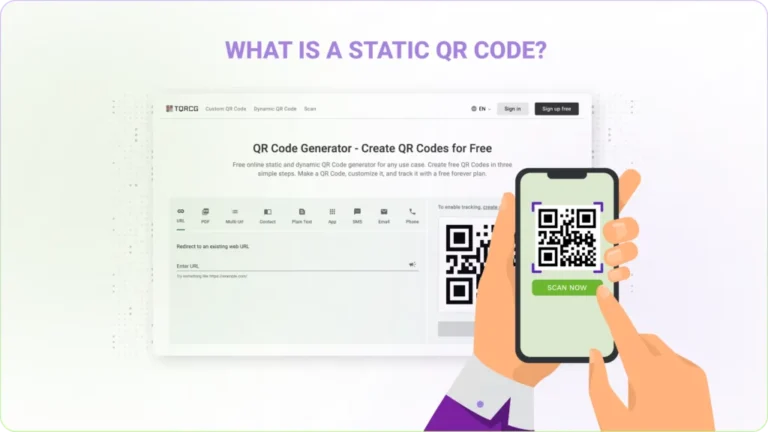
A Static QR Code generator is a simple yet powerful tool that allows users to create QR codes containing fixed information. Once generated, the data embedded in a static QR code cannot be edited or updated.
These QR codes are widely used for sharing permanent information such as website URLs, contact details, Wi-Fi credentials, product information, and text content.
Due to their simplicity, reliability, and cost-effectiveness, static QR codes remain one of the most popular QR code formats across industries.
What Is a Static QR Code?
A static QR code stores information directly within the code itself. When scanned, the QR reader decodes the embedded data and displays it instantly.

Since the information is hard-coded, there is no dependency on external servers or databases. This makes static QR codes ideal for long-term use cases where the content does not need to change.
For example, a QR code printed on product packaging that links to a company’s homepage is best created as a static QR code, as the destination URL is unlikely to change frequently.
How a Static QR Code Generator Works
A static QR code generator takes user input, such as a URL, text, email address, phone number, or file link, and converts it into a two-dimensional barcode.
The generator uses QR encoding standards to transform the data into black-and-white patterns that can be read by smartphones, scanners, and QR reader apps.
Most generators offer basic customization options such as:
- Changing QR code size and resolution
- Selecting foreground and background colors
- Adding simple frames or labels
- Downloading formats like PNG, SVG, or PDF
Once generated, the QR code can be downloaded and used both digitally and in print.
Key Features of Static QR Code Generators
- Permanent Data Storage
The information remains unchanged after creation, ensuring consistency and reliability. - No Subscription Required
Many QR code generators offer static QR codes for free, making them ideal for individuals and small businesses. - Offline Functionality
Static QR codes do not require internet access to function, except when the content itself is a web link. - High Compatibility
They work with almost all QR scanners and Smartphone cameras. - Long-Term Usability
Since there is no dependency on external platforms, static QR codes can remain functional indefinitely.
Common Use Cases
Static QR codes are widely used across different sectors:
- Marketing & Advertising: Website links, social media pages, promotional content
- Business Cards: Contact details, email addresses, LinkedIn profiles
- Retail & Packaging: Product information, manuals, warranty details
- Education: Study material links, notes, assignments
- Hospitality: Wi-Fi access, menu PDFs, location maps
Their reliability makes them especially suitable for printed materials such as posters, flyers, brochures, and packaging.
Advantages of Static QR Codes
- One of the biggest advantages of static QR codes is their simplicity. They are easy to create, free to use, and require no ongoing maintenance.
- Since the data is embedded directly, there is no risk of broken links caused by expired subscriptions or disabled dashboards.
- Additionally, static QR codes are highly secure in terms of data permanence. Once printed, the content cannot be altered, ensuring transparency and trust for users scanning the code.
Limitations to Consider
- Despite their benefits, static QR codes do have limitations. The most notable drawback is the inability to edit the content after creation.
- If a URL changes or information needs updating, a completely new QR code must be generated and redistributed.
- Another limitation is the lack of tracking and analytics. Static QR codes do not provide scan data such as location, device type, or scan count, which are often available with dynamic QR codes.
Static vs. Dynamic QR Codes
Static QR codes are best for fixed information and budget-friendly use cases, while dynamic QR codes are more suitable for marketing campaigns requiring flexibility and performance tracking. Choosing between the two depends on whether content updates and analytics are necessary.
Conclusion
A static QR code generator is an essential tool for anyone looking to share permanent information quickly and efficiently.
With no ongoing costs, easy creation, and universal compatibility, static QR codes remain a dependable solution for both personal and professional use.
While they lack advanced features like editing and analytics, their simplicity and reliability make them ideal for long-term, fixed-content applications.